



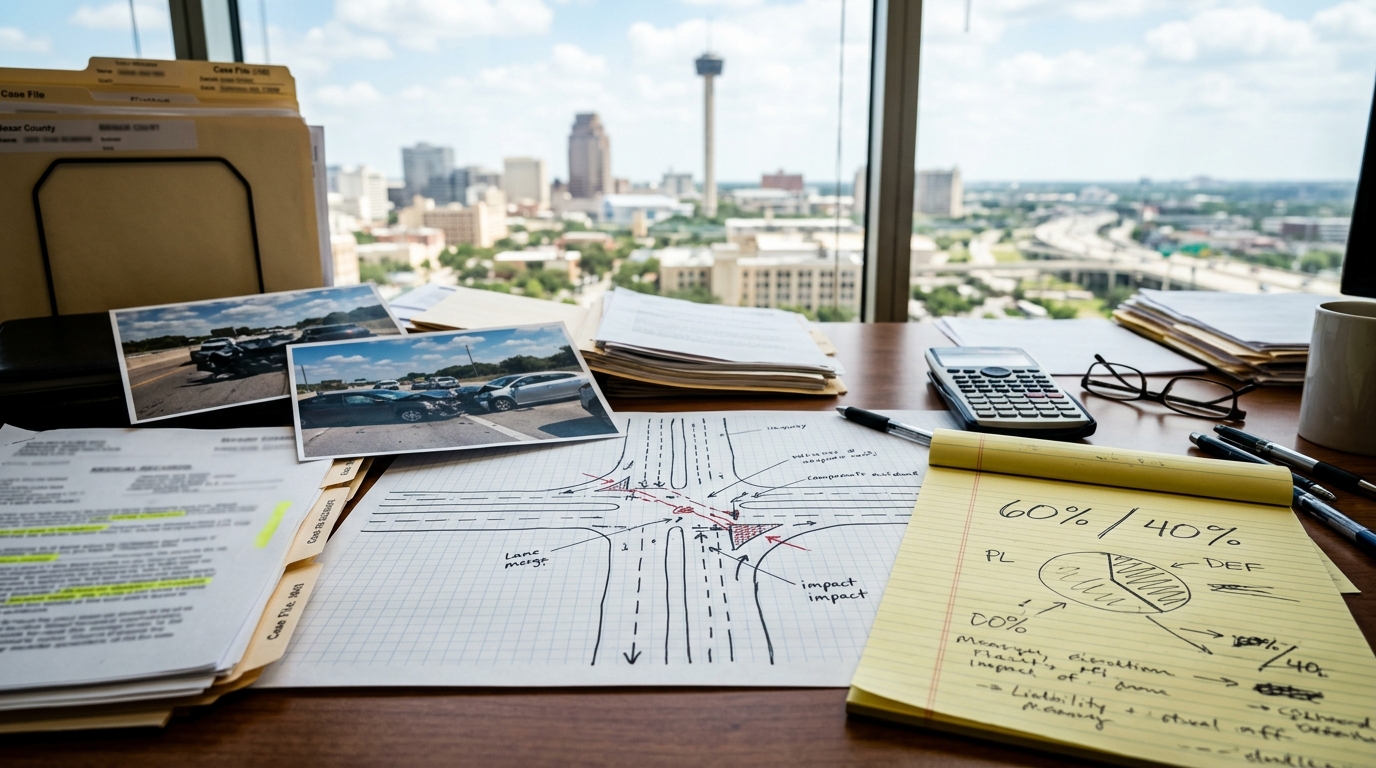
After an accident, you might feel certain about what happened. Another driver pulled into your lane, someone ran a red light, or a vehicle behind you failed to stop in time.
Then the insurance company raises a different question: Could you have done something to prevent the accident?
That question can change the direction of an injury claim.
Texas law recognizes that more than one person can contribute to an accident. But being accused of sharing responsibility does not automatically mean you lose your right to compensation.
The important questions are how responsibility is established, what evidence supports the percentages being discussed, and how Texas law applies to the circumstances.
If you were injured in San Antonio, understanding these rules can help you make sense of an insurance company’s position and decide what to do next.
The Short Answer: How Comparative Negligence Works in Texas
Texas follows a modified comparative responsibility system under Chapter 33 of the Texas Civil Practice and Remedies Code.
In applicable injury cases:
- You may still recover compensation if you share some responsibility, provided your percentage of responsibility does not exceed 50%.
- Your recoverable damages are generally reduced by your percentage of responsibility.
- If you are found more than 50% responsible, you cannot recover damages under the statute.
These rules come from Texas Civil Practice and Remedies Code Chapter 33, including Sections 33.001 and 33.012.
For example, suppose a claim has $100,000 in damages and the injured person is found 20% responsible. Under the general statutory calculation, the recoverable amount would be reduced by 20%, leaving $80,000 before other applicable adjustments.
That is an illustration of the legal calculation, not a prediction of what an insurance company will offer or what a particular claim is worth.
What Does Comparative Negligence Actually Mean?
Think about a collision on a busy San Antonio road.
One driver makes an unsafe lane change. Another driver is traveling faster than the posted speed limit. The vehicles collide, and one driver suffers an injury.
The investigation may need to consider both drivers’ actions.
The question is not simply whether a collision occurred. It is whether each person’s conduct contributed to the harm and, if so, to what extent.
Comparative negligence is the familiar term for this type of analysis. Texas statutes use the term proportionate responsibility.
Under Section 33.003, the factfinder determines percentages of responsibility for the relevant parties when supported by sufficient evidence. Depending on the case, that can include the claimant, defendants, settling parties, and certain responsible third parties.
This distinction matters because the other driver’s insurance company does not get to turn an accusation into an established fact merely by repeating it.
A disputed percentage needs to be considered in light of the evidence and applicable law.
The 51% Rule: Why The Percentage Matters
Texas’s rule is sometimes called the 51% bar.
The basic threshold is straightforward: under Section 33.001, a claimant cannot recover damages in an action governed by Chapter 33 if their percentage of responsibility is greater than 50%.
Here is how the general rule works in a simplified example.
| Injured person’s responsibility | Illustrative damages before reduction | Amount after comparative-fault reduction |
| 0% | $100,000 | $100,000 |
| 20% | $100,000 | $80,000 |
| 40% | $100,000 | $60,000 |
| 50% | $100,000 | $50,000 |
| 51% | $100,000 | No recovery under the statutory threshold |
These figures illustrate the general rule and assume no other applicable adjustments. Actual claims may involve additional legal issues, settlement credits, coverage limitations, or disputes over the damages themselves.
Notice that 50% and 51% produce very different results under the statute. That is one reason a disagreement over fault percentages can become so important.
How Comparative Negligence Can Affect Common Accidents In San Antonio
Shared-responsibility questions can arise in many kinds of injury claims. The details vary depending on the accident.
Car accidents
Imagine a collision at a busy intersection. One driver turns left across oncoming traffic, while the other is alleged to have been speeding.
The investigation might consider the signal, right of way, vehicle speeds, sightlines, and available video.
Neither driver’s version of events should be treated as conclusive without considering the evidence.
Rear-end collisions
A rear-end crash often raises questions about following distance and reaction time. Other facts might also matter, including whether traffic stopped suddenly or whether another vehicle cut into the lane.
The type of collision alone does not resolve every question about responsibility.
Truck accidents
A commercial vehicle collision may involve a truck driver, another motorist, a motor carrier, or additional parties, depending on the circumstances.
Investigators may need to consider driver conduct, vehicle condition, cargo, available records, and the actions of other road users.
Pedestrian accidents
When a pedestrian is injured, the investigation may examine visibility, traffic signals, crossing locations, driver actions, and the surrounding conditions.
The circumstances of the particular incident matter. The fact that a pedestrian was outside a designated crossing, for example, does not by itself answer every question about legal responsibility.
Slip-and-fall injuries
Comparative responsibility can also arise in premises-liability cases.
Relevant questions may include the nature of the hazard, whether the property owner knew or should have known about it, what warnings were provided, and what the injured person could reasonably have observed.
The rules and evidence applicable to a premises claim can differ from those in a vehicle collision.

What Evidence Can Influence A Fault Determination?
When drivers disagree about what happened, evidence can help establish the sequence of events.
The most useful evidence depends on the accident, but several categories commonly matter.
Photographs and video
Photos taken soon after a crash may show vehicle damage, road markings, traffic signals, visibility, and vehicle positions.
Dashcam footage or video from nearby businesses may help clarify how the collision occurred. Not every camera records the relevant area, and footage may not always be available.
Witness accounts
An independent witness may have seen a vehicle change lanes, a driver enter an intersection, or traffic slow before a collision.
Record witness contact information when it is safe to do so. A witness’s account should still be evaluated alongside the rest of the evidence.
Police reports
An accident report can provide useful information about the location, involved parties, observations, and reported circumstances. It is one piece of the evidence, not necessarily a complete resolution of every disputed issue.
Vehicle damage and physical evidence
The location and nature of vehicle damage may help investigators assess the collision. More detailed cases may require additional technical analysis.
Medical and financial records
Medical records help document the injuries and treatment. Bills, employment records, and receipts may support claimed losses.
These documents do not automatically determine who caused the accident, but they can help establish the consequences of the incident.
The Texas Department of Insurance’s guidance on what to do after a wreck recommends taking photographs, collecting witness information, recording accident details, and keeping medical records and bills.
Why An Insurance Company Might Say You Share The Blame
After an accident, an adjuster may review the evidence and take the position that you contributed to the collision.
Depending on the circumstances, the insurer might argue that you:
- Were traveling too fast for the conditions.
- Followed another vehicle too closely.
- Failed to observe a hazard.
- Changed lanes unsafely.
- Did not yield when required.
- Contributed to the incident in another way.
The existence of one of these allegations does not establish that it is correct.
Ask what facts support the insurer’s position. Does it rely on a witness statement, a photograph, a police report, video, or another source?
A clear explanation gives you something specific to evaluate rather than leaving you with a percentage and no meaningful reasoning.

Does Sharing Some Responsibility Mean You Should Accept A Lower Settlement?
Not automatically.
An insurance company’s assessment is a position taken during the claims process. It is not necessarily the final determination of responsibility.
Before evaluating an offer, consider several separate questions:
Is the proposed fault percentage supported by evidence? A percentage should be examined in light of the available facts, not accepted simply because the insurer assigns it.
Have the claimed losses been documented? Medical expenses, lost income, and other recoverable damages need appropriate support.
Is the injury’s longer-term impact understood? If treatment is ongoing, you may not yet know the full extent of the medical consequences.
What does the proposed settlement resolve? Read the release and understand which claims and rights you would be giving up.
A settlement can provide certainty and resolve a dispute, but it may also bring the claim to an end. If the fault assessment or the settlement terms are unclear, consider getting advice before signing.
Can You Challenge A Comparative Negligence Argument?
You can question an insurer’s position and provide evidence supporting your account.
Practical steps include:
- Ask the adjuster to explain the proposed fault allocation.
- Request clarification about the evidence supporting the position.
- Preserve photographs, video, witness details, and other relevant records.
- Keep medical bills and records documenting your injuries.
- Review any disputed facts carefully before responding.
- Consider legal advice if the disagreement could substantially affect your recovery.
Avoid exaggerating or guessing about what happened. If you do not remember a detail, it is better to say so than to speculate.
What If More Than Two Parties Were Involved?
Some accidents involve several potentially responsible parties.
For example, a collision might involve multiple motorists, or an incident might raise questions about the conduct of a business or another third party.
Texas Chapter 33 addresses how percentages of responsibility may be determined for multiple parties in applicable cases. The statute also contains rules concerning the amount of recovery and the liability of defendants.
The legal consequences can become more complicated when several parties are involved, when one party has settled, or when responsibility is disputed.
A simple two-driver example may not accurately describe those cases. The applicable provisions and facts need to be examined together.
How San Antonio Injury Victims Can Protect Their Records
You do not need to become a legal investigator to keep useful records. A simple, organized system is often enough to start.
Accident information
- Keep the police report or report number.
- Save photographs and videos.
- Record witness names and contact details.
- Note the date, location, and basic circumstances.
Medical information
- Keep medical bills and treatment records.
- Record appointments and follow-up recommendations.
- Keep receipts for relevant out-of-pocket expenses.
Financial information
- Save pay stubs and employer records if you missed work.
- Keep receipts for accident-related expenses.
- Record other documented changes to your finances.
Insurance communication
- Keep letters and emails.
- Record the adjuster’s contact information.
- Note the dates and substance of important calls.
- Save written settlement offers and releases.
The Texas Department of Insurance’s accident-claim guidance offers practical recommendations for collecting information and retaining documentation after a crash.
When Might A San Antonio Personal Injury Lawyer Help?
Some injury claims are relatively straightforward. Others involve serious injuries, conflicting accounts, multiple parties, or significant disagreements over responsibility.
Legal guidance may be worth considering when:
- The insurer assigns you a substantial share of fault.
- The evidence does not appear to support the insurer’s explanation.
- Several parties may have contributed to the accident.
- Your injuries require substantial treatment.
- You have lost income or expect continuing limitations.
- You are being asked to sign a release while important questions remain unresolved.
A personal injury lawyer in San Antonio, TX may help you understand the evidence, the applicable legal rules, and the options available for addressing a disputed claim.
You can also explore Thompson Law’s broader personal injury lawyers resources.
Whether you need legal representation depends on your circumstances. The goal is to understand the issues before making a decision that could affect your rights.
Frequently Asked Questions
1. What is the comparative negligence rule in Texas?
Texas uses a modified comparative responsibility system under Chapter 33 of the Civil Practice and Remedies Code. In applicable cases, a claimant’s damages are reduced by their percentage of responsibility, and a claimant found more than 50% responsible cannot recover damages under Section 33.001.
2. Can I recover damages if I was 50% at fault in Texas?
Under the general rule in Section 33.001, the bar applies when the claimant’s responsibility is greater than 50%. A claimant found exactly 50% responsible is not barred by that threshold alone, although damages are reduced and other legal issues may affect the outcome.
3. Who determines the percentage of fault after an accident?
Insurance companies may assess responsibility while evaluating claims. If a case proceeds to litigation, the factfinder determines percentages of responsibility as required by applicable law and based on sufficient evidence. An insurer’s assessment is not automatically a final court determination.
4. What evidence can help dispute a fault percentage?
Depending on the accident, useful evidence may include photographs, video footage, witness accounts, police reports, vehicle damage, roadway conditions, and other relevant records.
5. Should I accept a settlement if the insurer says I was partly responsible?
Do not decide based on the percentage alone. Consider the supporting evidence, the documented losses, the terms of the release, and the consequences of settling. If the disputed percentage could materially affect your recovery, consider seeking legal advice before signing.
Final Thoughts
Being told you share responsibility for an accident can be discouraging, especially when you are already dealing with injuries, medical appointments, and financial pressure.
But an insurance company’s position is not the whole story.
Texas law provides a framework for assessing responsibility, reducing damages according to a claimant’s percentage of fault, and barring recovery when that percentage exceeds 50% in applicable cases.
The evidence matters. So does understanding how the law applies to your circumstances.
Keep your records, ask questions about disputed fault, and take time to understand a settlement before agreeing to it.
For local information, visit the Thompson Law San Antonio profile.

