



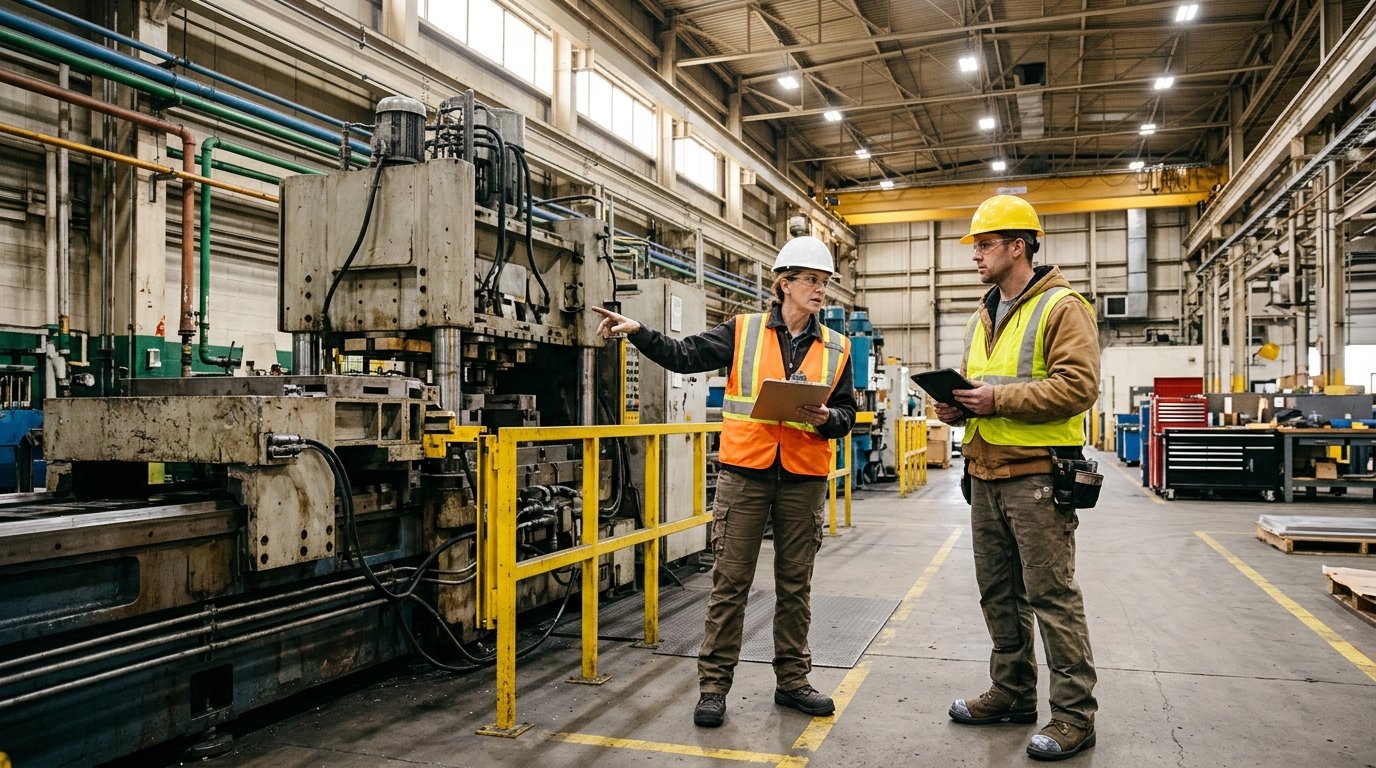
Industrial accidents can cause serious injuries when unsafe equipment, negligent contractors, defective machinery, or dangerous property conditions expose workers to preventable hazards. These incidents may occur in manufacturing facilities, warehouses, processing plants, distribution centers, construction projects, and industrial maintenance operations.
In New York, injured employees may qualify for workers’ compensation benefits regardless of ordinary employer negligence. A separate personal injury claim may also be available when a property owner, outside contractor, equipment manufacturer, or another legally responsible third party contributes to an accident.
However, liability is not automatic simply because an injury occurs on industrial property. Determining responsibility requires examining who controlled the work area, who created the hazard, which safety duties applied, and how the accident occurred.
Quick Answer
Can an injured industrial worker sue a contractor or property owner in New York?
Yes. An injured worker may pursue a third-party personal injury claim when a contractor, property owner, equipment manufacturer, or another party owes and breaches an applicable legal duty and causes the injury.
Potential claims may involve negligent equipment operation, unsafe premises, defective machinery, or inadequate maintenance. Qualifying construction-related activities may also involve New York Labor Law §§ 200, 240(1), and 241(6).
However, workers’ compensation generally restricts ordinary negligence lawsuits against the injured worker’s covered employer. Claims against other parties require independent proof of liability.
Key Takeaways
- Multiple Responsible Parties: Industrial accidents may involve facility owners, outside contractors, equipment operators, maintenance providers, and manufacturers.
- Property Owner Liability: Responsibility often depends on control of the premises, knowledge of dangerous conditions, and involvement in the injury-producing work.
- Contractor Negligence: Outside companies may face liability when negligent equipment operation, repairs, or maintenance cause injuries.
- Workers’ Compensation: Qualifying employees generally receive benefits through their employer’s workers’ compensation coverage.
- Third-Party Claims: Injured workers may pursue separate claims against legally responsible parties other than their covered employer.
- Construction Safety Laws: Labor Law §§ 240(1) and 241(6) apply to qualifying construction-related activities, not every industrial accident.
- Important Evidence: Maintenance records, service agreements, equipment inspections, surveillance footage, and witness statements may help establish liability.
- Filing Deadlines: Workers’ compensation, private-party lawsuits, and government-related claims have different deadlines.
What Types of Industrial Accidents Can Involve Contractors and Property Owners?
Industrial facilities contain machinery, storage systems, loading areas, elevated work platforms, and equipment operating zones.

Multiple companies may work in these areas simultaneously, creating situations where responsibility for an accident is disputed.
Heavy Machinery Accidents
Industrial equipment can generate substantial force during manufacturing, lifting, processing, and material handling.
Common hazards include:
- Exposed moving components
- Malfunctioning hydraulic equipment
- Defective machine guards
- Unexpected equipment movement
- Improperly operated industrial presses
- Unstable machinery
- Damaged control systems
- Inadequate equipment maintenance
An accident may involve a machine owned by the facility, maintained by an outside contractor, and operated by an employee of another company.
The investigation must determine which party’s conduct was legally responsible.
Forklift and Material Handling Accidents
Forklifts are frequently used in warehouses, factories, loading docks, and construction supply areas.
Potential accidents include:
- Forklifts striking pedestrians
- Materials falling from elevated forks
- Improperly secured loads
- Vehicles tipping over
- Collisions with storage systems
- Unsafe loading and unloading
- Malfunctioning lifting equipment
- Equipment operated without adequate precautions
A forklift accident may involve negligent operation by a third-party delivery company or defects associated with equipment maintenance.
The equipment’s ownership, operator’s employer, and worksite control may all matter.
Industrial Maintenance Accidents
Industrial facilities often hire outside companies to repair machinery, maintain electrical systems, inspect equipment, or perform specialized services.
These workers may encounter hazardous conditions while servicing equipment.
Potential problems include:
- Unexpected machine startup
- Uncontrolled hydraulic movement
- Improperly supported equipment
- Exposed electrical components
- Defective access platforms
- Unsafe confined work areas
- Inadequate energy isolation
- Dangerous conditions left after maintenance
The legal analysis may examine whether the accident resulted from the facility’s condition or the contractor’s own work methods.
Loading Dock Accidents
Loading docks frequently involve commercial vehicles, industrial equipment, pallets, and moving materials.
Accidents may occur when a worker is struck by equipment or injured by an unstable load.
Potentially responsible parties may include the facility operator, delivery contractor, trucking company, or another business.
Industrial Falls
Workers may slip, trip, or fall because of dangerous walking surfaces.
Examples include:
- Oil or grease spills
- Broken industrial flooring
- Uneven loading areas
- Damaged walkways
- Unprotected openings
- Improperly maintained stairways
- Obstructed pedestrian routes
- Defective elevated platforms
A property owner may face liability when it negligently creates a hazardous condition or has legally sufficient notice and fails to address it.
Falling Object Accidents
Industrial facilities may store materials on elevated racks or transport heavy components using cranes, forklifts, or hoists.
Objects may fall because of inadequate securing, improper handling, or defective equipment.
An accident involving construction-related hoisting operations may raise different legal questions from one involving ordinary warehouse storage.
Electrical and Energy-Related Accidents
Contractors may work on electrical systems, powered equipment, and machinery containing stored energy.
Unexpected energization or equipment movement can create serious injury risks.
Responsibility depends on the applicable safety duties, equipment condition, maintenance arrangements, and accident circumstances.
Who Can Be Held Liable for an Industrial Workplace Accident?
The potentially responsible defendants depend on who owned, controlled, operated, supplied, maintained, or negligently affected the equipment or property.
Industrial Property Owners
A property owner may face liability when an injury results from a dangerous condition for which the owner had a legally recognized responsibility.
For example, a facility owner may negligently allow a known hazardous walking surface to remain unrepaired.
However, owning industrial property does not automatically create liability for every accident involving independent contractors.
The owner’s control and applicable duties are important.
Facility Operators
The company operating a manufacturing plant or warehouse may differ from the property’s legal owner.
The facility operator may control daily activities, equipment use, maintenance, and worksite procedures.
Its responsibility depends on the specific legal relationship and accident.
Outside Maintenance Contractors
Industrial facilities regularly hire service providers to inspect and repair equipment.
A maintenance company may face liability when negligent repairs, improper installation, or failure to satisfy an applicable duty cause injuries.
However, simply having a maintenance contract does not automatically establish liability.
Equipment Operators
A separate company may supply forklift operators, crane operators, or specialized machinery personnel.
When an operator negligently causes an accident while working for that company, the company may face responsibility under appropriate legal principles.
The investigation must establish the employment relationship and whether the operator acted within the scope of assigned duties.
Equipment Manufacturers
Manufacturers may face liability when a legally actionable product defect causes an injury.
Potential claims may involve defective design, manufacturing errors, or inadequate warnings.
The relevant product liability requirements must be established separately.
General Contractors
A general contractor may oversee construction, renovation, demolition, or other qualifying work within an industrial facility.
Certain construction safety statutes may impose special duties.
However, those duties should not automatically be extended to ordinary industrial production or unrelated maintenance activities.
Subcontractors
Subcontractors may operate equipment, control work areas, or perform specialized repairs.
A subcontractor may face liability when its own negligent conduct causes an injury or when it qualifies as a statutory agent under applicable construction law.
A workplace accident lawyer may evaluate these relationships when determining which parties may face a valid injury claim.
When Is an Industrial Property Owner Responsible for a Worker’s Injury?
Property owner liability depends on the legal duty owed and the cause of the accident.
New York courts distinguish accidents arising from dangerous premises conditions from those involving the methods used to perform work.
That distinction is especially important in claims involving construction or industrial contractors.
Dangerous Premises Conditions
A dangerous premises condition is a hazard associated with the property or work environment.
Examples may include:
- Damaged industrial flooring
- Unsafe permanent stairways
- Known overhead hazards
- Recurring liquid accumulation
- Defective fixed equipment under the owner’s control
- Dangerous loading surfaces
- Improperly maintained access areas
- Unprotected openings
Liability may arise when the owner created the condition or had actual or constructive notice and failed to respond reasonably.
The relevant duty and control requirements still must be established.
Unsafe Work Methods
Some accidents result from how a contractor performs its assigned work.
For example, a maintenance contractor may improperly support a heavy machine while performing repairs.
In construction-related Labor Law § 200 claims, an owner or general contractor generally must have sufficient authority to supervise or control the injury-producing work when the accident arises from its means and methods.
General authority to inspect progress or enforce broad project rules is not always enough.
What Is Actual Notice?
Actual notice means the responsible party directly knew about the particular dangerous condition.
Evidence may include:
- Earlier accident reports
- Maintenance requests
- Inspection findings
- Written employee complaints
- Emails identifying an equipment problem
- Service tickets
- Reports of recurring hazards
The timing and specificity of these records matter.
What Is Constructive Notice?
Constructive notice may exist when a dangerous condition was visible and apparent and existed long enough for reasonable discovery and correction.
For example, a deteriorated industrial walkway that remained visibly damaged for weeks may present different notice issues from a spill occurring moments before an accident.
However, notice alone may not establish liability when the injury resulted from an independent contractor’s methods rather than a premises defect.
What If the Owner Did Not Supervise the Contractor?
A property owner may avoid certain negligence claims when it did not control the contractor’s injury-producing work.
However, a lack of direct supervision does not automatically eliminate every potential premises liability claim.
In qualifying construction activities, separate statutory duties under Labor Law §§ 240(1) or 241(6) may also apply.
How Does New York Labor Law § 200 Apply to Industrial Accidents?
New York Labor Law § 200 establishes general duties concerning reasonably safe workplaces.
The statute specifically addresses the placement, operation, guarding, and lighting of machinery and equipment.
However, the availability of a civil claim depends on the accident circumstances, the defendant’s legal responsibilities, and applicable negligence principles.
The New York State Senate’s Labor Law § 200 provides the statutory language.
What Does Section 200 Require?
Section 200 generally requires covered workplaces to be constructed, equipped, arranged, operated, and maintained in a manner providing reasonable and adequate protection.
It also addresses the safe operation and guarding of machinery and equipment.
The statute does not automatically establish that a property owner is responsible for every machinery accident at a facility.
What Is the Difference Between Premises Conditions and Work Methods?
Consider two hypothetical accidents.
In the first, an outside contractor trips over a long-standing defect in a factory’s walkway.
In the second, an outside contractor is injured because their coworker improperly operates a machine during repairs.
The first scenario may involve the owner’s knowledge and maintenance of the premises.
The second may involve the contractor’s work methods and the degree of control exercised by the parties.
Different evidence may be required.
Can More Than One Theory Apply?
Yes.
An accident may involve both a dangerous physical condition and negligent work methods.
For example, an unstable industrial platform may combine with unsafe equipment movement to cause a fall.
A court may need to evaluate both potential causes rather than focusing exclusively on one.
When Do Labor Law §§ 240(1) and 241(6) Apply?
New York provides additional protections for certain construction-related activities.
However, industrial facilities also perform ordinary manufacturing, production, maintenance, and equipment operations that may fall outside these statutes.
Labor Law § 240(1)
Section 240(1) addresses qualifying elevation-related hazards during specified work involving buildings or structures.
Covered activities may include erection, demolition, repairing, altering, painting, cleaning, and pointing, subject to statutory and judicial limitations.
Examples of potentially relevant accidents include falls from inadequately protected scaffolding or injuries caused by certain inadequately secured elevated loads.
However, an accident involving heavy industrial equipment does not automatically qualify.
Labor Law § 241(6)
Section 241(6) establishes safety duties concerning covered construction, excavation, and demolition work.
A claim generally requires a sufficiently specific, applicable New York Industrial Code provision and proof that its violation proximately caused the injury.
Generalized allegations of unsafe conditions are not enough.
What About Routine Industrial Maintenance?
Routine industrial production or ordinary equipment servicing may not qualify for these specialized construction protections.
The investigation must distinguish a covered building alteration or repair from ordinary equipment maintenance.
For example, installing structural components as part of a building renovation may involve different statutory issues from servicing a production machine during normal factory operations.
Are Property Owners Always Liable Under These Laws?
No.
Section 240(1) can impose a nondelegable duty when its requirements are satisfied.
Section 241(6) also establishes nondelegable duties within its scope, but requires an applicable, sufficiently specific regulation.
Neither statute automatically applies to every industrial accident merely because a property owner hired a contractor.
What Do Recent New York Court Decisions Say About Industrial and Contractor Injuries?
Recent New York decisions demonstrate why ownership, contractor authority, equipment operation, and the exact legal theory can affect liability.
Da Silva v. Delshah-OTL-Start 22 Chapel Property Owner, LLC (2026)
In Da Silva v. Delshah-OTL-Start 22 Chapel Property Owner, LLC, decided October 21, 2026, a construction worker allegedly injured his foot after stepping into a hole on a project floor.
The worker was carrying plywood forms when he encountered an opening that had been covered by a thin layer of cement.
The accident involved property owners, a general contractor, and the injured worker’s employer.
The Appellate Division, Second Department distinguished the worker’s Labor Law § 241(6) allegations from his Section 200 and common-law negligence claims.
The court determined that the Industrial Code provisions concerning passageway obstructions and debris did not apply to the alleged condition.
However, the court found that factual questions remained concerning the defendants’ authority to supervise the work and their constructive notice of the alleged hazard.
The court therefore reinstated the Labor Law § 200 and common-law negligence claims, while rejecting the particular Section 241(6) theories.
The ruling illustrates why an industrial or construction injury may support one legal theory but not another.
Acosta v. 22-12 Jackson Owner LLC (2026)
In Acosta v. 22-12 Jackson Owner LLC, decided June 30, 2026, a worker was injured when sheetrock fell from a forklift operated by an employee of a lumber supplier.
The worker was employed by a separate company and was disposing of construction debris.
The Appellate Division, First Department determined that the worker was entitled to summary judgment on his common-law negligence claim against the lumber supplier.
Expert evidence established that the forklift operator had improperly operated the machinery by failing to extend the forks sufficiently.
The appellate court also upheld Labor Law § 240(1) liability against certain covered construction defendants.
However, factual disputes remained concerning the general contractor’s supervision and control of the loading area, preventing dismissal of the Labor Law § 200 and negligence claims against that contractor.
The official decision in Acosta demonstrates how a single equipment accident may involve multiple defendants and different legal duties.
Mann v. Mezuyon, LLC (2026)
In Mann v. Mezuyon, LLC, decided May 26, 2026, a worker was injured at a Manhattan excavation project.
The worker was operating drilling equipment when a nearby excavator rotated and struck him.
The worker pursued construction safety claims, including Labor Law § 241(6).
The New York Court of Appeals examined whether Industrial Code § 23-4.2(k) was sufficiently specific to support statutory liability.
The provision generally prohibited permitting workers in areas where excavation machinery could endanger them.
However, the Court concluded that the regulation did not provide sufficiently concrete safety requirements to support a nondelegable duty under Section 241(6).
The court affirmed dismissal of that claim.
The Court of Appeals decision in Mann illustrates why citing a general equipment safety regulation does not necessarily establish liability.
Zhivov v. Kings Bay Housing Co., Inc. (2026)
In Zhivov v. Kings Bay Housing Co., Inc., decided May 6, 2026, a worker alleged that he fell from an unsecured A-frame ladder during demolition work.
The ladder allegedly became unstable because of an uneven floor.
The Appellate Division, Second Department examined claims involving the building owner and a separate company that owned the underlying land.
The court found that the building owner had not established a lack of constructive notice concerning the allegedly dangerous floor condition.
However, the separate landowner had demonstrated that it lacked a sufficient connection to the worker and the injury-producing work.
The court upheld dismissal of the claims against that landowner.
The appellate court also found factual disputes concerning the occurrence of the accident, preventing a final liability determination under Section 240(1) against the building owner at that stage.
The official decision in Zhivov demonstrates why ownership of underlying land does not always establish responsibility for an injury involving another entity’s building.
What Do These Decisions Demonstrate?
The decisions highlight several important distinctions:
- Ownership Is Not Enough: A property owner’s legal relationship to the accident location and relevant work must be established.
- Contractor Conduct Matters: Negligent equipment operation can support a direct claim against an appropriate contractor.
- Supervision Matters: Responsibility for directing the injury-producing work may affect ordinary negligence and Labor Law § 200 claims.
- Notice Matters: Dangerous conditions that an owner knew or should have known about may support certain premises claims.
- Specific Regulations Matter: Labor Law § 241(6) requires sufficiently specific and applicable Industrial Code provisions.
- Different Claims Have Different Requirements: An accident may support negligence liability while a statutory claim fails, or vice versa.
A court’s decision allowing a claim to proceed does not necessarily establish the defendant’s ultimate liability.
What OSHA Responsibilities Apply When Multiple Companies Share an Industrial Worksite?
The Occupational Safety and Health Administration recognizes that more than one employer may have safety responsibilities at a shared workplace.
OSHA’s Multi-Employer Citation Policy identifies several categories of employer responsibility.
Creating Employers
A creating employer causes a hazardous condition that violates an applicable OSHA standard.
For example, a contractor may remove a required machine guard and leave the machinery in an unsafe condition.
Depending on the circumstances, OSHA may cite the company responsible for creating the hazard.
Exposing Employers
An exposing employer has employees who are exposed to a hazardous condition.
For example, a maintenance contractor’s employees may work near equipment that another company left improperly guarded.
The exposing employer may have obligations to protect its employees even when it did not create the condition.
Correcting Employers
A correcting employer is responsible for correcting particular safety hazards.
A company hired to repair unsafe machinery or install required safety systems may fall within this category.
Its duties depend on the applicable standards and its role.
Controlling Employers
A controlling employer has sufficient authority to require correction of safety hazards at the worksite.
This authority may arise from contracts or actual practices.
However, determining the appropriate citation requires consideration of the relevant circumstances.
The OSHA Multi-Employer Citation Policy explains these categories and their enforcement implications.
Does OSHA’s Multi-Employer Policy Determine Civil Liability?
No.
OSHA’s policy concerns the agency’s ability to issue safety citations.
It does not automatically establish that a particular contractor or property owner is liable for personal injury damages under New York law.
A civil claim must independently establish a recognized legal duty, breach, causation, and damages or satisfy the requirements of an applicable statutory cause of action.
What Is Third-Party Liability in an Industrial Accident?
Third-party liability involves a claim against a legally responsible party other than the injured worker’s covered employer.
Industrial accidents frequently involve such claims because several businesses may work within the same facility.
Example: An Outside Contractor Causes a Forklift Accident
Consider a hypothetical scenario.
A manufacturing employee is injured when a forklift operated by an outside delivery company’s employee drops an improperly secured load.
The injured employee may qualify for workers’ compensation through the manufacturing employer’s coverage.
A separate negligence claim may also be available against the delivery company if negligent forklift operation caused the injury.
Example: A Contractor Is Injured by Unsafe Facility Equipment
A maintenance technician employed by an outside service company is injured while repairing machinery at a factory.
The accident allegedly results from a defective hydraulic support system that the factory operator knew was malfunctioning.
A potential claim may involve the facility owner or operator if an applicable duty, breach, and causation can be established.
However, responsibility depends on the condition, control of the equipment, maintenance agreements, and accident circumstances.
Example: Defective Equipment Causes an Industrial Injury
A worker is injured when a safety component on an industrial machine fails during ordinary use.
A product liability claim may be available against an appropriate manufacturer if the machine contained a legally actionable defect.
The worker must establish the defect and its causal connection to the injuries.
Why Is the Third Party’s Identity Important?
Different defendants may be subject to different legal requirements.
An equipment manufacturer may face a product liability claim.
A contractor may face ordinary negligence liability.
A property owner may be responsible for a dangerous premises condition.
Understanding third-party liability in industrial accidents can help clarify the differences between workers’ compensation and claims against outside parties.
Can an Industrial Worker Receive Workers’ Compensation and Sue a Contractor?
Potentially, yes.
New York’s workers’ compensation system and third-party personal injury lawsuits provide different legal remedies.
What Does Workers’ Compensation Cover?
Qualifying employees may receive benefits that include:
- Necessary medical treatment
- Partial wage replacement
- Benefits for certain permanent impairments
- Certain rehabilitation-related services
- Death benefits for qualifying dependents
Workers’ compensation generally does not require proof of ordinary employer negligence.
Can an Employee Sue Their Direct Employer?
Usually, an employee cannot bring an ordinary negligence lawsuit against a covered employer for a qualifying workplace injury.
Workers’ Compensation Law § 11 generally makes compensation benefits the exclusive remedy, subject to statutory exceptions.
For example, failure to secure legally required workers’ compensation coverage may affect the employee’s available remedies.
What About Claims Against Independent Contractors?
A separate claim may be available when an outside contractor negligently causes the accident.
Workers’ compensation exclusivity does not automatically protect every unrelated company operating at the facility.
However, the claim requires evidence establishing the contractor’s independent legal responsibility.
What Is Workers’ Compensation Law § 29?
Workers’ Compensation Law § 29 governs certain third-party recoveries involving employees who receive workers’ compensation benefits.
Its provisions address compensation carrier reimbursement rights, liens, settlement requirements, and circumstances affecting control of the third-party cause of action.
The New York State Senate’s Workers’ Compensation Law § 29 provides the statutory framework.
The possibility of receiving workers’ compensation and third-party damages does not mean an injured employee can recover the same losses without accounting for applicable reimbursement rules.
Can a Property Owner or Contractor Shift Liability to the Worker’s Employer?
Sometimes, but New York law places important restrictions on claims for contribution and indemnification against a covered employer.
What Is Contribution?
Contribution generally concerns one defendant’s attempt to recover part of a loss from another legally responsible party.
For example, a property owner may argue that a maintenance contractor should share responsibility for an injury.
However, employer-related restrictions may affect whether such a claim is available.
What Is Indemnification?
Indemnification may allow one party to recover all or part of a liability payment from another under appropriate circumstances.
It may arise from a valid contract or certain common-law principles.
What Does Workers’ Compensation Law § 11 Require?
Section 11 generally restricts third-party contribution and common-law indemnification claims against an injured worker’s covered employer unless the worker sustained a statutorily defined grave injury.
The statute separately recognizes certain express contractual indemnification obligations.
What Is a Grave Injury?
A grave injury is defined narrowly by statute.
The listed categories include death, certain amputations or permanent total loss of use, paraplegia or quadriplegia, and specified other severe injuries.
An injury may be serious or permanently disabling without meeting the statutory definition.
Importantly, the grave-injury requirement concerns certain claims against the employer. It is not a general requirement for an employee to pursue an otherwise valid claim against an independent third party.
Are All Indemnification Clauses Enforceable?
No.
Construction-related indemnification agreements may be subject to New York General Obligations Law § 5-322.1, which restricts certain agreements purporting to indemnify a party for its own negligence.
The wording of the contract and the circumstances matter.
What Evidence Is Important in an Industrial Accident Claim?
Industrial accident investigations may require technical evidence and documents identifying who controlled the equipment or work area.

| Evidence | Why It Matters |
| Accident Scene Photographs | Documents equipment and property conditions |
| Surveillance Footage | May establish the sequence of events |
| Incident Reports | Records initial observations |
| Machinery Identification | Helps identify the exact equipment involved |
| Maintenance Records | May show previous defects and repairs |
| Equipment Inspection Logs | Documents operating condition and safety checks |
| Service Contracts | Helps identify contractor responsibilities |
| Property Ownership Records | Identifies owners and operators |
| Worksite Safety Plans | May clarify assigned safety duties |
| Training Documentation | May identify relevant procedures and instructions |
| Witness Statements | Provides independent accounts |
| OSHA Records | May reveal regulatory findings |
| Expert Evaluations | Helps establish equipment failures and accident causes |
| Medical Documentation | Establishes injuries and treatment |
| Financial Records | Supports claims involving earnings losses and other damages |
Equipment Maintenance Records
Service records may reveal recurring malfunctions, incomplete repairs, or earlier reports of dangerous conditions.
They may also identify which company was responsible for maintenance.
Service Agreements and Contracts
Contracts can help establish whether a property owner, facility operator, or outside contractor had responsibility for particular equipment or tasks.
However, contractual responsibilities do not automatically resolve every question of civil liability.
Surveillance Footage
Video may show a forklift collision, equipment malfunction, or dangerous worksite condition.
Relevant footage may be overwritten after a limited period.
Witness Statements
Coworkers, supervisors, contractors, and delivery personnel may provide information about how the accident happened.
Witnesses may also know about earlier safety complaints.
Expert Evaluations
Qualified engineers or other specialists may examine machinery, hydraulic components, equipment guards, and operating records.
Technical evaluations may be necessary when the parties disagree about the accident’s cause.
Medical Documentation
Medical records help establish the injuries and resulting limitations.
Emergency treatment, diagnostic imaging, surgery records, rehabilitation notes, and work restrictions may become important.
What Should Someone Do After an Industrial Workplace Accident?
The immediate priority is emergency assistance and protection from continuing hazards.
Once urgent needs are addressed, several steps can help preserve the relevant information.
1. Seek Medical Attention
Obtain emergency care for serious injuries, including crush injuries, fractures, head trauma, amputations, and spinal injuries.
2. Report the Accident
Notify the direct employer or appropriate supervisor.
New York workers’ compensation generally requires notice within 30 days, subject to exceptions.
3. Identify the Accident Location
Document the facility, department, work area, and equipment involved.
4. Identify the Companies Present
Record the names of the property owner, facility operator, outside contractors, and other businesses involved when known.
5. Document Equipment and Conditions
Photograph relevant equipment or hazards when safe.
Do not interfere with emergency response or attempt to manipulate dangerous machinery.
6. Identify Witnesses
Collect contact information from people who observed the accident or knew about the hazard.
7. Preserve Relevant Records
Save maintenance requests, safety complaints, service records, and incident documentation.
8. Identify Surveillance Cameras
Determine whether relevant video or machinery data may exist.
9. Keep Medical and Financial Documentation
Maintain treatment records, medical bills, prescriptions, wage records, and work restrictions.
10. Review Workers’ Compensation and Third-Party Deadlines
Different legal procedures may apply depending on the claim and defendants.
What Injuries Can Result From Industrial Accidents?
Industrial accidents can cause injuries ranging from temporary physical limitations to permanent disability.
Crush Injuries
Heavy equipment and machinery may compress parts of the body.
These injuries can damage bones, nerves, muscles, and blood vessels.
Amputations
Contact with cutting equipment or moving machinery may result in partial or complete amputations.
Treatment may involve surgery, prosthetic devices, and long-term rehabilitation.
Traumatic Brain Injuries
Workers struck by equipment or falling materials may suffer concussions or more serious brain injuries.
Spinal Injuries
Equipment collisions and falls may cause spinal fractures, disc injuries, or spinal cord trauma.
Fractures and Orthopedic Injuries
Workers may suffer broken arms, legs, ribs, wrists, or other bones.
Burns and Electrical Injuries
Electrical equipment, hot machinery, and industrial processes may cause serious burns or other injuries.
Long-Term Functional Limitations
Permanent injuries may restrict physical activity, employment, and independence.
Medical and vocational evidence may be important when assessing long-term losses.
What Compensation May Be Available After an Industrial Accident?
Workers’ compensation benefits and third-party personal injury damages provide different forms of recovery.
| Potential Loss | Workers’ Compensation | Qualifying Third-Party Lawsuit |
| Medical Treatment | Generally covered under applicable benefit rules | Potentially recoverable, subject to applicable law and reimbursement |
| Lost Earnings | Statutory wage replacement | Potential recovery for documented income losses |
| Permanent Impairment | Certain statutory disability benefits | May support recoverable damages |
| Reduced Earning Capacity | Some benefits may apply | Potential future earnings damages |
| Pain and Suffering | Not a separate ordinary benefit | Potentially recoverable |
| Long-Term Care | May be covered under benefit rules | Potentially recoverable when legally supported |
| Wrongful Death | Qualifying death benefits | Potential wrongful death damages |
Medical Expenses
Compensation may involve emergency treatment, hospitalization, surgery, rehabilitation, medication, and future medical care.
Lost Earnings
An injured worker may be unable to return to work during recovery.
Documented lost income may be relevant to a third-party claim.
Reduced Earning Capacity
Permanent injuries may prevent the worker from performing previous industrial duties.
Future losses require medical, financial, and vocational evidence.
Pain and Suffering
A qualifying third-party lawsuit may permit compensation for physical pain, emotional distress, and reduced enjoyment of normal activities.
Long-Term Rehabilitation
Severe injuries may require prosthetic devices, continuing treatment, mobility equipment, or personal assistance.
Wrongful Death Damages
Fatal industrial accidents may result in workers’ compensation death benefits and potentially a separate wrongful death claim against legally responsible third parties.
Can Comparative Negligence Reduce an Industrial Injury Claim?
Yes, depending on the cause of action.
Workers’ compensation generally operates without requiring proof of employer fault.
Ordinary negligence lawsuits, however, may involve comparative negligence.
How Does Comparative Negligence Work?
Under CPLR § 1411(a), an injured person’s legally attributable negligence generally reduces recoverable damages according to their percentage of responsibility.
Consider a hypothetical example:
| Factor | Illustrative Amount |
| Total Legally Established Damages | $150,000 |
| Injured Person’s Share of Fault | 20% |
| Comparative Negligence Reduction | $30,000 |
| Remaining Damages | $120,000 |
This example illustrates ordinary proportional fault reduction only and is not a settlement estimate.
Is Using Dangerous Equipment Automatically Negligent?
No.
Industrial workers often operate machinery as part of assigned duties.
The analysis must consider the equipment, training, instructions, safety precautions, and circumstances.
An injured worker is not automatically negligent merely because the job involved dangerous equipment.
What About Labor Law § 240(1)?
Ordinary comparative negligence is not a defense to an established Section 240(1) violation that proximately caused the injury.
However, a defendant may assert a recognized sole-proximate-cause defense.
That statute applies only to qualifying elevation-related activities.
Do New York’s 2026 Comparative Fault Changes Apply?
New York amended CPLR § 1411 in 2026 for certain actions governed by Insurance Law Article 51.
Those changes generally concern qualifying motor vehicle injury cases.
They do not ordinarily govern conventional industrial premises liability and contractor negligence claims.
How Long Does Someone Have to File an Industrial Accident Claim in New York?
Different deadlines apply to workers’ compensation, private-party negligence lawsuits, and certain government-related claims.
| Claim or Requirement | General Deadline |
| Report a workplace injury to the employer | Generally within 30 days |
| File a workers’ compensation claim | Generally within two years |
| Ordinary personal injury lawsuit against a private third party | Generally three years |
| Certain municipal tort claims | Notice of claim generally required within 90 days |
| Covered municipal negligence action | Generally one year and 90 days |
| Certain claims against New York State | Special Court of Claims filing and service procedures |
| Wrongful death action | Generally two years, subject to exceptions |
What Is the Workers’ Compensation Reporting Deadline?
New York generally requires an injured employee to notify the employer within 30 days.
Certain exceptions may apply.
Prompt written notice can help document the accident.
What Is the Workers’ Compensation Filing Deadline?
Qualifying workers generally must file a claim with the Workers’ Compensation Board within two years, subject to applicable exceptions.
The New York Workers’ Compensation Board’s filing guidance explains the reporting and claim process.
What Is the Deadline for a Third-Party Lawsuit?
CPLR § 214(5) generally establishes a three-year filing period for ordinary personal injury actions.
However, Workers’ Compensation Law § 29 contains additional rules affecting certain third-party causes of action, reimbursement rights, and possible assignment of claims.
The applicable requirements should be evaluated together.
What If a Government Entity Is Involved?
Certain municipal tort claims require a notice of claim within 90 days under General Municipal Law § 50-e.
Claims against New York State follow separate Court of Claims Act procedures.
Other public authorities may have entity-specific requirements.
The correct defendant and legal theory determine the applicable deadlines.
Why Is Early Evidence Preservation Important?
Industrial facilities may return equipment to operation shortly after an accident.
Machines may be repaired, hazardous conditions corrected, and surveillance recordings overwritten.
Preserving evidence early can help establish the original accident circumstances.
What Mistakes Can Weaken an Industrial Accident Claim?
Several common mistakes may complicate a workplace injury claim.
These include:
- Failing to report the accident promptly
- Not identifying the companies involved
- Assuming the property owner is automatically liable
- Assuming an outside contractor is always responsible for equipment problems
- Overlooking maintenance and service agreements
- Failing to identify who controlled the work
- Not preserving photographs or surveillance footage
- Discarding defective equipment components
- Failing to collect witness information
- Confusing premises defects with unsafe work methods
- Assuming OSHA citations automatically establish civil liability
- Assuming construction-specific Labor Law provisions apply to routine industrial operations
- Overlooking manufacturer-related claims
- Assuming workers’ compensation eliminates every third-party lawsuit
- Delaying necessary medical treatment
- Failing to document permanent disability and lost income
- Missing workers’ compensation or lawsuit deadlines
A properly supported claim requires evidence of the relevant duty, negligent conduct or statutory violation, causation, and resulting damages.
When May Legal Guidance Be Useful?
Legal guidance may be especially valuable when an industrial accident involves multiple contractors, disputed equipment responsibilities, serious injuries, or long-term disability.

Additional investigation may be needed when a property owner claims an outside contractor controlled the accident-producing work or when a maintenance company disputes responsibility for a defective machine.
Complex cases may involve technical equipment inspections, OSHA records, industrial service agreements, construction contracts, workers’ compensation benefits, and multiple insurance policies.
People researching local legal services may review a Farmingdale legal office location when seeking information about industrial workplace injury claims in Nassau or Suffolk County.
Every claim depends on its circumstances. An industrial accident does not automatically establish property owner or contractor liability.
Frequently Asked Questions About Industrial Accident Claims
Can an industrial worker sue a property owner after a workplace accident?
Yes, in certain circumstances. A property owner may face liability when it breaches a legally recognized duty concerning dangerous premises conditions or injury-producing work. However, ownership alone does not establish negligence. The claim generally requires evidence of the owner’s relevant control, notice where required, causation, and compensable injuries.
Can someone sue an outside contractor for an industrial accident?
Potentially, yes. An outside contractor may face liability when negligent equipment operation, repairs, or maintenance causes an injury. The injured worker must establish the contractor’s legal duty, breach, causation, and damages. Workers’ compensation exclusivity generally concerns the worker’s own covered employer rather than every unrelated contractor.
Does New York Labor Law § 240(1) apply to industrial machinery accidents?
Not automatically. Section 240(1) addresses qualifying elevation-related hazards during specified construction-related activities. Ordinary manufacturing and routine equipment servicing generally do not become covered simply because heavy machinery is involved. Other negligence, product liability, or workplace safety principles may apply depending on the accident.
Can a worker receive workers’ compensation and file a third-party injury claim?
Yes, when legally permitted. Workers’ compensation may provide medical and wage benefits, while a separate lawsuit may be available against a negligent contractor, property owner, or manufacturer. Workers’ Compensation Law § 29 establishes rules affecting third-party recovery, reimbursement, and certain claim procedures.
How long does someone have to file an industrial accident lawsuit in New York?
Many ordinary third-party personal injury lawsuits have a three-year deadline. Workers’ compensation generally requires employer notice within 30 days and claim filing within two years, subject to exceptions. Government-related claims and additional Workers’ Compensation Law § 29 requirements may affect filing procedures and timing.
Conclusion
Industrial accident claims involving contractors and property owners in New York require careful investigation because several companies may have different responsibilities for equipment, maintenance, property conditions, and workplace operations.
A property owner may face liability for a dangerous premises condition when the applicable legal requirements are established. An outside contractor may be responsible for negligent equipment operation or repairs, while a manufacturer may face a separate claim involving a defective product.
New York court decisions demonstrate why the distinction between premises conditions and unsafe work methods matters. Ownership, contractual responsibilities, notice, actual supervision, and the availability of specific statutory protections can determine which claims remain viable.
Workers’ compensation generally provides benefits for qualifying workplace injuries while restricting ordinary negligence lawsuits against covered employers. However, separate third-party claims may be available against other legally responsible parties.
Equipment maintenance records, service agreements, site safety documentation, surveillance footage, witness statements, and medical records can help establish the accident circumstances and resulting losses.
Understanding New York’s premises liability principles, workplace safety requirements, third-party claims, recoverable damages, and filing deadlines can help injured industrial workers evaluate potential legal remedies using reliable evidence.

